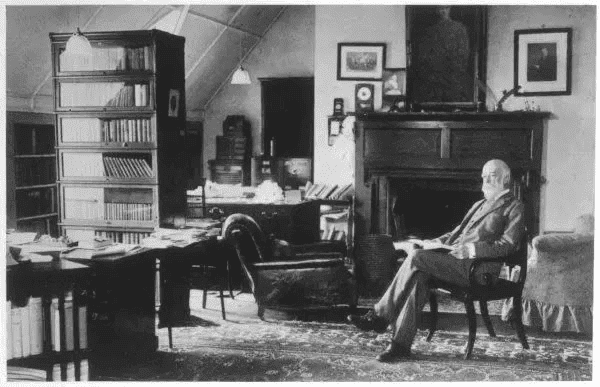
Oliver Joseph Lodge was a distinguished scientist, educator, inventor, thinker, spiritualist, president of the Society for Psychical Research, writer, and a father to many. From 1900 to 1920, he held the esteemed position of the first Principal of the University of Birmingham. Find out more at birmingham1.one.
Biographical Details
Oliver Lodge was born in 1851 in Penkhull, a historic district of Stoke-on-Trent. His grandfathers were clergymen, and his father owned a business supplying clay to the pottery industry.

Oliver was the firstborn in the Lodge family, with eight brothers and one sister. Several of his siblings also became prominent figures in Great Britain. Richard Lodge was a historian; Eleanor became an academic, serving as vice-principal of Lady Margaret Hall at Oxford and principal of Westfield College in London; and Alfred Lodge distinguished himself in mathematics, becoming the first president of The Mathematical Association.
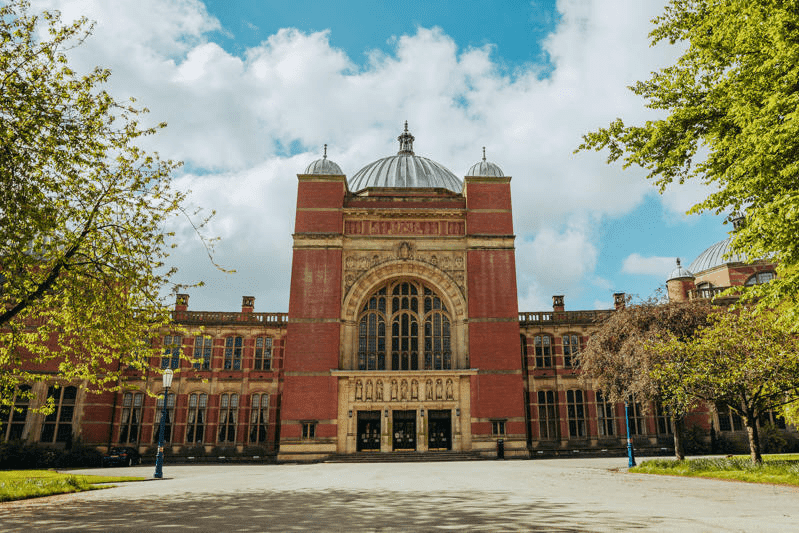
Oliver received his early education at Adams’ Grammar School in Newport. At the age of 12, driven by his interest in the natural sciences, particularly physics, he attempted his first scientific experiments. At 14, he had to postpone his studies to help with his father’s business. The business proved profitable, and the family moved to the more affluent West Midlands area of Hanley. At 18, Oliver occasionally attended physics lectures in London and at the Wedgwood Institute. Applying his new theoretical knowledge, he conducted practical experiments in his father’s outbuildings. In 1875, he earned a bachelor’s degree from the University of London, and in 1877, he defended his doctoral dissertation. By 1881, Oliver had become a professor of physics and mathematics at University College, Liverpool. In 1900, he was appointed the first Principal of the University of Birmingham, where he worked until his retirement.
In 1877, Oliver Lodge married, and the couple had 12 children. His eldest son became a writer and poet, his youngest was killed during World War I, and others founded their own businesses using their father’s scientific achievements.
Scientific Discoveries
In 1873, the publication of James Clerk Maxwell’s “A Treatise on Electricity and Magnetism” captured the young student’s attention. However, Lodge did not yet have enough knowledge to fully grasp the Scottish physicist’s theoretical propositions. In his early scientific papers, Oliver described electrical phenomena from a mechanical perspective—focusing on polarization and conductivity—rather than from an electrodynamic one. He was most interested in the luminiferous ether and the electromagnetic waves that manifest by filling space. He later articulated his thoughts on electromagnetism in his work “Modern Views of Electricity.” The ether and its potential properties remained a subject of Lodge’s research for his entire life; even when the scientific world was captivated by Einstein’s special and general theories of relativity, Oliver wrote a book titled “Ether and Reality.”
In 1887, representatives of the Royal Society of Arts invited Oliver Lodge to lecture on lightning, as existing lightning rods made of copper cables were not always effective, sometimes failing to prevent building damage. The physicist conducted specific experiments which determined that a high-resistance charge could take a shorter path due to the effects of inductance, bypassing the copper loop designed to divert the lightning. The scientist’s findings led to improved designs for these devices.
In 1888, Lodge studied the work of Heinrich Hertz, who had discovered the electromagnetic waves—or “Hertzian waves”—predicted by Maxwell, and noted that they behaved according to the laws of light. Oliver conducted his own experiments to confirm their existence. One day, in a dark room, he noticed a glowing wire, which he took as proof of their presence. He wrote a paper on the subject, emphasizing the similarity of radio waves to light, including their ability to be reflected and transmitted, and acknowledged Hertz’s discovery.
In 1894, at a meeting of the British Science Association, Lodge was the first to demonstrate the successful transmission of a signal over a distance of 40 meters using radiotelegraphy. However, he did not pursue the research or publish a paper on it, and the scientific society recorded the event merely as an experiment, not a discovery. For this reason, Oliver Lodge is considered one of the inventors of radio signaling, although other scientists, including Alexander Popov and Guglielmo Marconi, presented their results a year later.
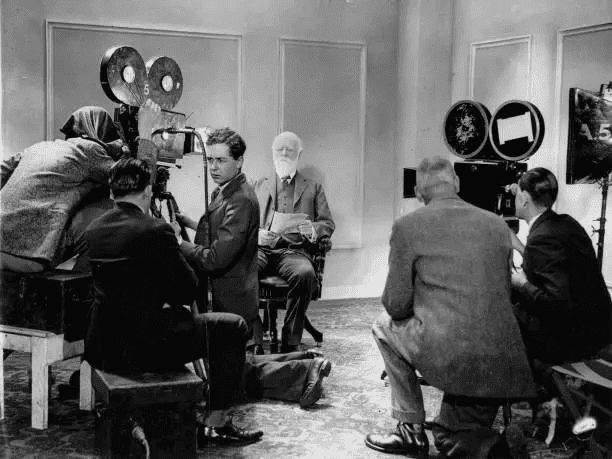
Lodge later focused on wireless information transmission and developed the principles upon which radio receivers and transmitters were based. These principles continue to be used in 21st-century analog electronics. He registered a patent for a method of using an inductor coil and an antenna circuit for radio—essentially, a way to tune to a specific station—which he sold to the Marconi Company in 1912.

Lodge’s undisputed inventions include the moving-coil loudspeaker, whose design has barely changed over a century, and the spark plug for internal combustion engines. His sons founded the successful Lodge Plug company, which manufactured spark plugs for cars and aircraft.
Pseudoscientific Theories and Writing
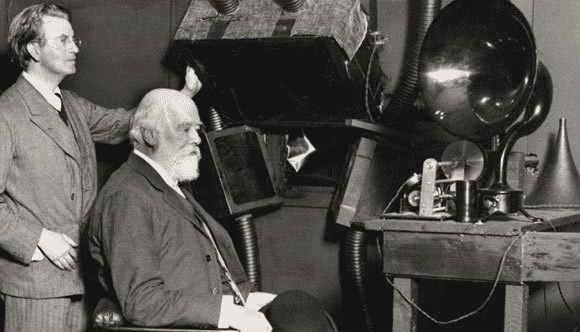
Despite being recognized as a brilliant scientist and inventor during his lifetime, Oliver Lodge seriously contemplated quasi-scientific theories, including the possibility of life after death and thought transference. Lodge began studying telepathy in the 1880s, and in the early 20th century, he was a member of The Ghost Club and president of the London-based Society for Psychical Research.
He explained his belief in the survival of human consciousness after death and the possibility of communicating with loved ones in the afterlife through his Christian faith and his own understanding of the ether. The ether, in his view, filled the entire universe, including the spiritual realm. He saw Christ’s resurrection as a demonstration of how an etheric body could manifest in the material dimension. In the late 1900s, Oliver published a series of books developing his theory of spiritual evolution, including “Man and the Universe” and “The Survival of Man.”
To find evidence of the afterlife, Lodge conducted experiments with mediums who helped him communicate with his son, Raymond, who was killed in World War I. In 1916, he published the book “Raymond, or Life and Death,” which became a bestseller. In it, Lodge detailed what he had learned from his son, including that the spiritual world is similar to the earthly one but without disease, and that all fallen soldiers received cigars and whiskey. Such claims were heavily criticized by scientists, and Lodge became the subject of caricatures. However, some scientists, like Max Planck, showed interest in his unconventional research into telepathy. Lodge’s views were also shared by author Arthur Conan Doyle, who had also lost a son in the war and used the services of mediums.
Honors and Tributes
Oliver Lodge was a Fellow of the Royal Society, which awarded him the Rumford Medal in 1898 for his outstanding research in physics. In 1902, the scientist’s services to the nation were recognized when he was knighted by King Edward VII. In 1919, Lodge received the Albert Medal for his contributions to the advancement of science. In 2007, his name was inducted into the U.S. National Inventors Hall of Fame, which honors distinguished individuals for technical innovations that serve social and economic progress. A primary school in Vanderbijlpark, South Africa, is named in honor of Oliver Lodge.
Despite his unconventional research and conclusions regarding spiritualism, telepathy, and spiritual evolution, Oliver Lodge remains one of Great Britain’s honored citizens. In Birmingham, he is revered as the university’s first Principal and a distinguished resident of the city.